Podcasts & Publications
CURE-KY Podcast and Publication Spotlights
This page features a curated collection of podcast episodes and research publications relevant to infectious disease, public health, and translational science, with a particular emphasis on work connected to the CURE-KY community.
Each month, we highlight publications selected by CURE-KY leadership for its relevance, insight, or impact. In addition to these monthly spotlights, we regularly share other notable content—including external podcast episodes and recent peer-reviewed publications authored by CURE-KY members. All featured publications are accompanied by an AI-generated audio summary to help make the research more accessible to broader audiences.
Whether you're catching up on timely studies or tuning into expert conversations, we invite you to explore the content below—and if you know of a podcast or paper that aligns with our mission or includes a member of the CURE-KY network, please share it with us.
CURE-KY October Spotlight
PMID: 41127172
Journal: Antimicrob Steward Healthc Epidemiol
Title: Candida auris screening, positivity trends, and patient characteristics at the University of Kentucky between 2021 and 2024.
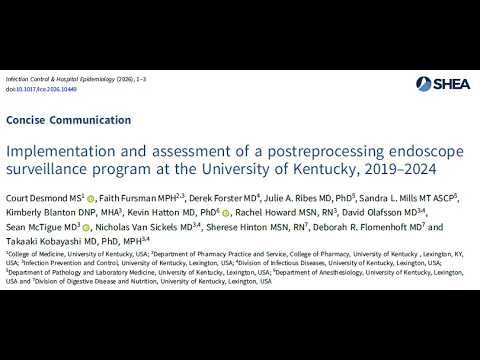
Authors: Fursman F, Fitzsimmons N, Overton D, Desmond C,Blanton K,Hatton KW,Howard R,Olafsson D,McTigue S,Van Sickels N,Forster D, Kobayashi T
Funding: None
Impact on KY: The study demonstrated that implementing a targeted Candida auris screening program at the University of Kentucky led to a 0.96% positivity rate and a marked rise in community-onset case detection from 8% to 54%. The findings suggests that structured screening of this emerging pathogen enables earlier identification of colonized patients and improved infection control.
Published: Oct 23, 2025
PMID: 41078008
Journal: Clin Transl Med
Title: Soluble IL-2R: A potential therapeutic target for mitochondrial dysfunction in post-COVID fatigue syndrome
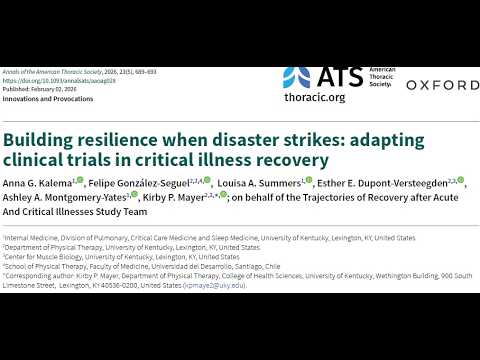
Authors: Brown LP,Joshi J, Kosmac K, Long DE, Scott L, El-Amouri S, Montgomery-Yates AA, Kalema AG, Sturgill JL, Vekaria H, Sullivan PG, Wilburn D, Koutakis P, Latham CM, Fry CS, Kern PA, Miller BF, Dupont, Versteegden EE, Ismaeel A, Mayer KP, Wen Y
Funding: University of Kentucky College of Health Sciences Pilot Grant Program
NIH UL1TR001998
NIH K23-AR079583
NIH R01-AR081002
NIH R00-AR081367
NIH P50MD019476
Impact on KY: Soluble IL-2 receptor (sIL2R) was identified a novel mediator of mitochondrial dysfunction in post-COVID fatigue syndrome, linking immune activation to impaired muscle energetics. The work highlights a potential novel therapeutic target and biomarker for treating long COVID–related fatigue.
Published: Oct 13, 2025
CURE-KY September Spotlight
Journal: The Lancet
Title: Artificial intelligence and infectious diseases: an evidence driven conceptual framework for research, public health, and clinical practice
Authors: Anna Odone*, Chiara Barbati*, Silvia Amadasi, Tanja Schultz, David B Resnik
An AI summary of the three Artificial Intelligence and Infectious Diseases papers published in the The Lancet journal. The following summary is provided by the authors: "As artificial intelligence (AI) is projected to radically shape health care, its role in infectious disease prevention and management is drawing attention. AI offers promising opportunities to help tackle infectious disease threats and improve clinical management, outbreak detection, and infection control. As part of a dedicated Series on AI and infectious diseases, this paper sets the scene by proposing a conceptual framework that, building upon available AI models and data sources related to pathogens, human hosts, and the environment, comprehensively identifies selected domains where AI can be applied across infectious disease research, public health, and clinical practice. Building on this foundation, the two companion papers in the Series follow with an in-depth exploration of AI applications in diagnostics and antimicrobial resistance. We provide an overview of current and future applications of AI in infectious disease prevention and management, exploring the broad potential, available experimental evidence, real-life implementation examples, and technical normative, ethical, and policy barriers."
PMID: 40920035
Journal: J Virol
Title: Genomic characterization of arboviruses discovered between the 1950s and 1980s
Authors: Claro IM, Hua X, Viveros A, Moreira FRR, Proença-Módena JL, Plante KS, Weaver SC, de Souza WM
Funding:
(226075/Z/22/Z)./WT_/Wellcome Trust/United Kingdom
R24 AI120942/AI/NIAID NIH HHS/United States
1022448/Burroughs Wellcome Fund
Impact on KY: The historic evolution of arboviruses is critical to understand the risk of endemic and pandemic spread. Evaluation of previously unsequenced arboviruses from 23 countries, provide additional insight into their diversity, evolution, and pathogenic potential.
Published: Sep 8, 2025
PMID: 40893419
Journal: Open Form Infect Dis
Title: Propensity-matched comparison of timely vs. delayed antibiotic therapy in Stenotrophomonas maltophilia Pneumonia
Authors: Kunz Coyne AJ, Lucas K, Gray R, May E
Funding: UL1TR001998 – NIH NCATS
Impact on KY: Patients with S maltophilia represent a challenging population to treat due to antimicrobial resistance. Timely therapy initiated within 48 hours based on a retrospective Kentucky population indicated a 22.8% absolute reduction in mortality at 30 days providing clinical guidance for therapeutic intervention.
Published: Sep 2, 2025
Previous Spotlights
PMID: 40864371
Journal: Cancer Causes Control
Title: Group concent mapping to develop a salon-based HPV self-collection intervention
Authors: Palmer KNB, Mantina MN, Adegboyega A, Sokale IO, Pryor K, Suero-Davis A, Brooks T
Funding: IRG-18-161-40/American Cancer Society
Impact on KY: Engaging communities in hair salons to address the lack of access to cervical cancer screening. Their strategy established a collaborative approach to enhance screening in unconventional sites.
Published Online: August 27, 2025
PMID: 40851273
Journal: Equine Vet J
Title: Airborne detection of Equid alphaherpesvirus1 at international equestrian events
Authors: Khan A, Jose-Cunilleras E, Hyde E, Olajide E, Polo MC, Goehring LS
Funding: International Equestrian Federation
Impact on KY: There is an urgent need for surveillance of EHV-1 in equestrian events globally. These data demonstrate the utility of air and surface sample testing at equestrian events in KY and globally as the first step in measuring risk of exposure that could cause an EHV-1 outbreak in the horse industry.
Published Online: August 25, 2025
PMID: 40641522
Journal: Environ Adv
Title: Clinical correlation of SARS-CoV-2 wastewater passive sampling in long-term care facilities and wastewater treatment plants.
Authors: Strike W, Rockward A, Mijatovic B, Noble A, Olsson C, Torabi S, Banadaki MD, Adatorwovor R, Keck J, Berry S
Funding: NIH: P30ES026529, U01DA053903
Impact on KY: Comparative assessment of sample collection strategies at different facilities (wastewater treatment plants and long-term care facilities) to determine optimal sample collection to detect SARS-CoV-2 demonstrating passive sampling as advantageous at low viral genome concentrations.
Published online: July 11, 2025
PMID: 40587129
Journal: JAMA Netw Open
Title: Disparities in Human Papillomavirus-Associated Cancer Incidence by Appalachian Residence.
Authors: Burus T, Windon MJ, Jakubek YA, Lang Kuhs KA
Funding: NIH: K22CA258678
Impact on KY: Disproportionately high HPV-associated cancer rates among Appalachian residents compared to non-Appalachian residents highlighting the need for improved vaccine uptake.
Published online: July 1, 2025
PMID: 40541539
Journal: EBioMedicine
Title: MyD88 signalling in B cells and antibody responses during Oropouche virus-induced neurological disease in mice.
Authors: Toledo-Teixeira DA,Parise PL,Pereira da Silva BB, Simeoni CL, Vieira A, Forato J, Martini MC, Amorim MR, Bispo-Dos-Santos K, Brunetti NS, Fabiano de Souza G, Coimbra LD, Fontoura MA, Muraro SP, Barbosa PP, Matheus VA, Hua X, Mendes de Moraes Vieira PM, Granja F, Lalwani P, Ramirez Vinolo MA, Milanez GP, Marques RE, Fielding CA, Marciel de Souza W, Farias ADS, Price DA, Diamond MS, Silveira ELV, Proenca-Modena JL
Funding: São Paulo Research Foundation (FAPESP), National Council for Scientific and Technological Development (CNPq), Coordination for the Improvement of Higher Education Personnel (CAPES), Unicamp Research Affairs Office, PIPAE University of São Paulo, Wellcome Trust, and National Institute of Science and Technology on Photonics Applied to Cell Biology (INFABIC, Unicamp).
Impact on KY: Increases understanding of the immune signaling and correlates of protection in mice exposed to Oropouche virus currently found in central and South America, but risk is elevated in the US as spread is likely. Dr. de Souza quoted here describing potential impacts.
Published online: June 21, 2025
PMID: 40519989
Journal: Blood Vessel Thromb Hemost
Title: Unfolded von Willebrand factor binds protein S and reduces anticoagulant activity.
Authors: Sim MMS, Mollica MY, Alfar HR, Hollifield M, Chung DW, Fu X, Gandhapudi S, Coenen DM, Prakhya KS, Mahmood DFD, Banerjee M, Peng C, Li X, Thornton AC, Porterfield JZ, Sturgill JL, Sievert GA, Barton-Baxter M, Zheng Z, Campbell KS, Woodward JG, López JA, Whiteheart SW, Garvy BA, Wood JP
Funding: NIH: R01HL138179, R35HL150818, K99HL129193, TL1TR001997, T32HL007093
Impact on KY: Excellent demonstration of collaboration across CURE-KY with at least 6 PIs as coauthors. Provides an explanation for the risk of thrombosis during viral infection, like SARS-CoV-2, in which free protein S is depleted and loses its anticoagulant capacity.
Published online: June 16, 2025
PMID: 40187345
Journal: Cell
Title: Molecular basis for shifted receptor recognition by an encephalitic arbovirus
Authors: Fan X, Li W, Oros J, Plante JA, Mitchell BM, Plung JS, Basu H, Nagappan-Chettiar S, Boeckers JM, Tjang LV, Mann CJ, Brusic V, Buck TK, Varnum H, Yang P, Malcolm LM, Choi SY, de Souza WM, Chiu IM, Umemori H, Weaver SC, Plante KS, Abraham J
Funding: (deSouza): Wellcome Trust grant 226075/Z/22/Z
Impact on KY: After a recent outbreak of Western equine encephalitis virus (WEEV) in humans and horses in South America, this team studied ancestral strains of WEEV to elucidate structure and function with cell receptors that explain the dynamics of viral evolution and have implications in outbreak preparedness.
Published online: May 29, 2025
PMID: 40422074
Journal: ASM - Journal of Virology
Title: Screening bacterial effectors and human virus proteins in yeast to identify host factors driving tombusvirus RNA recombination: a role for autophagy and membrane phospholipid content.
Authors: Pogany J, Inaba J-i, Liu Y, Nagy PD
Funding: National Science Foundation (IOS-1922895) National Institute of Food and Agriculture (2020-70410-32901, KY012042)
Impact on KY: This study provides tools to identify bacterial effectors that can improve pathogen detection and disease prevention in Kentucky’s agriculture and biosafety sectors.
Published online: May 27th, 2025