The University of Kentucky Public Relations & Strategic Communications Office provides a weekly health column available for use and reprint by news media. This week's column is by Ellen J. Hahn, PhD, director of BREATHE at the University of Kentucky College of Nursing and director of UK Center for Appalachian Research in Environmental Sciences (UK-CARES).
Director Dr. Ellen Hahn Discusses "What to Know About Radon in Your Home"
Faculty Fellow Dr. Vince Venditto Discusses "COVID Vaccines: Fact Versus Fiction"
LEXINGTON, Ky. (Jan. 14, 2021) — Over the past year, a novel, highly contagious virus has spread across the world. Scientists and researchers have worked quickly to respond with vaccine development, two of which have been approved by the U.S. Food and Drug Administration (FDA) for emergency use so far.

Faculty Fellow Dr. Chad Risko Discuss the Future of Energy Storage on 'Behind the Blue'
LEXINGTON, Ky. (Jan. 8, 2021) — What will the future of energy storage look like?

Why COVID-19 Vaccine Research Remains Critical
LEXINGTON, Ky. (Jan. 22, 2021) — While the Pfizer and Moderna COVID-19 vaccines continue to be administered across the United States under an emergency authorization status, ongoing coronavirus vaccine research and development remain critical to the fight against the global pandemic.
The emergency authorization allows us to protect people now, but research will continue for decades, says University of Kentucky College of Medicine vaccine researcher Jerry Woodward.
Deadline 2/19/21 - CHET Undergraduate Essay Competition
Award: First Place - $250
Second Place - $100
Overview

Deadline 2/19/21 - CHET Equity Changemaker Award
Award: $500
Purpose
The purpose of the Center for Health Equity Transformation (CHET) Equity Changemaker Award is to recognize the efforts of University of Kentucky graduate students, professional students, and ost-doctoral scholars in advancing health equity through research and training. Annual awards will be made to individuals whose research seeks to understand health disparities and inequities and whose mentorship has contributed to the next generation of health equity scholars.

2021 Saha Awards for Cardiovascular Research and Education
The Saha Awards are given to encourage and support staff and students with an interest in and dedication to cardiovascular medicine. Each award includes an unrestricted $1000 prize, a certificate and recognition at the University of Kentucky Gill Heart Institute Cardiovascular Research Day held on September 10, 2021 at the Gatton Student Center.
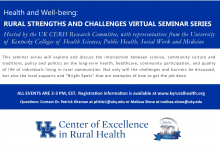
Registration is Open for Rural Strengths and Challenges Virtual Seminar Series
Registration is now open for the Health and Wellbeing: Rural Strengths and Challenges Virtual Seminar Series, hosted by the UK Center of Excellence in Rural Health Research Committee, with representation from the UK Colleges of Health Sciences, Public Health, Social Work and Medicine.
Markey Names Rogers as Director of Kentucky Cancer Program – East
LEXINGTON, Ky. (Jan. 20, 2021) – The University of Kentucky Markey Cancer Center announces the appointment of Mindy Rogers as director of the Kentucky Cancer Program – East, which is housed within the Cancer Center.

UK Study Potentially Links Low Blood Amylin Level to Reduced Progression of Alzheimer’s Disease
LEXINGTON, Ky. (Jan. 20, 2021) — More than 5.7 million Americans live with Alzheimer’s disease and that number is projected to triple by 2050. Despite that growing number, there is not yet a cure.