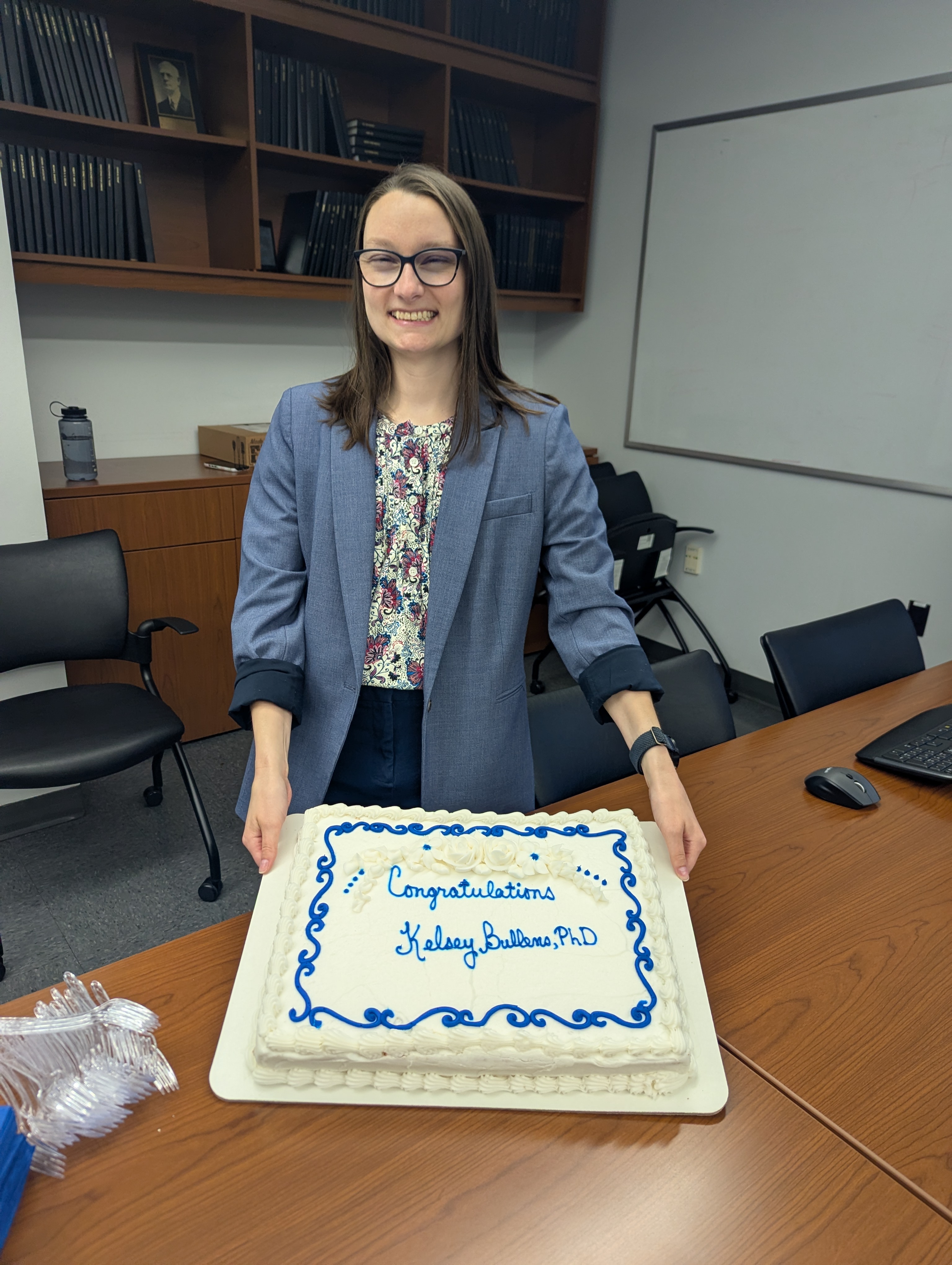
On Wednesday, June 24, 2026, Kelsey Bullens successfully defended her dissertation and earned her doctoral degree in physiology. Congratulations, Dr. Bullens!
Regional Differences in the Control and Regulation of Exocrine Glands: Role of RAAS and Sympathetic Cholinergics
Exocrine glands generate and secrete vital fluids including respiratory secretions, milk, digestive juices, urine, and sweat, but are difficult to extract and study due to location. The integument houses many exocrine glands; most abundantly eccrine sweat glands. Eccrine sweat glands are excellent model exocrine glands because they are ubiquitous, numerous (about 2-5 million in total), simple in structure, and easily accessible. We investigated how the autonomic nervous system (sympathetic cholinergic) and the Renin-Angiotensin-Aldosterone System (RAAS) modulate eccrine sweat gland secretions and surrounding tissues. For neuronal experiments, transepithelial resistance and ion flux were measured in mouse paw pad skin (with eccrine sweat glands) and tails (without eccrine sweat glands) via Ussing chambers with sympathetic cholinergic agonists and a local heat stress. We show that paws have decreased transepithelial resistance with increasing cholinergic agonist concentration and during local heat stress compared to tail skin and to normal skin temperature. For mouse hormonal experiments, a high dose of Angiotensin II (Ang II) was infused into mice via osmotic mini-pumps for 28 days. After, mRNA expression of RAAS-related transporters and receptors (Angiotensin II Receptor-Associated Protein (Agtrap), Epithelial Sodium Channel (ENaC), Mineralocorticoid Receptor (MR), and Na+/K+-ATPase) was measured in paw skin, tail skin, and kidney (reference RAAS tissue). In female mice infused with Ang II for 28 days, mRNA expression decreased in tissue with sweat glands (paws) only. Conversely, gene expression increased in male 28-day Ang II infusion paw tissue. These changes were not observed in tail or kidney tissue with 28 days of Ang II infusion. These data indicate a systemic increase in RAAS disparately regulates related transporters and receptors in female compared to male mice. Translational experiments with human skin explant tissues treated with aldosterone have been implemented. Though current sample sizes are small, we were able to detect a significant decrease in gene expression of the mineralocorticoid receptor. Protein quantification is currently in progress. Combined, these studies reveal regional differences in exocrine gland regulation by external stimuli through neural and hormonal pathways.