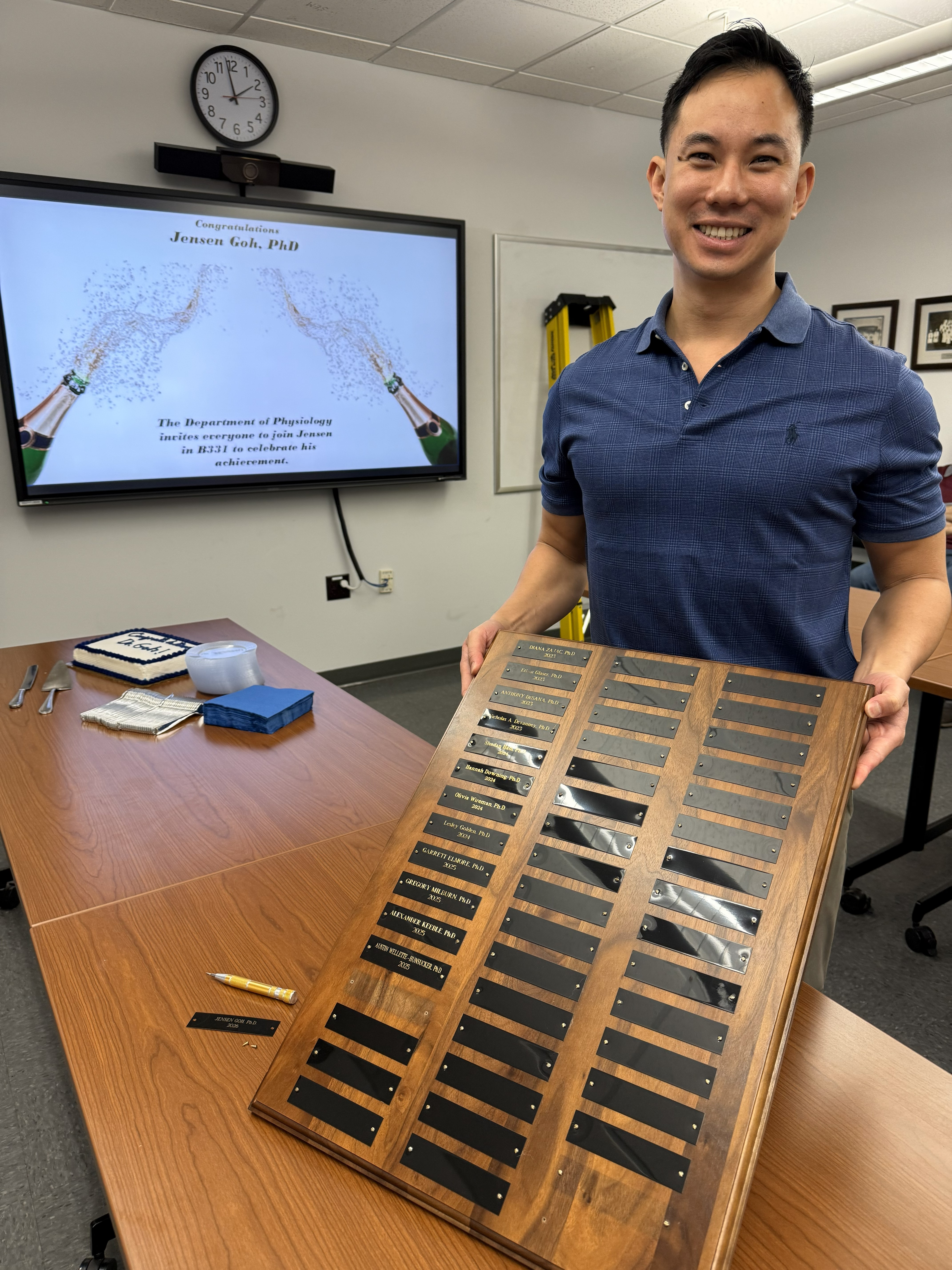
On Friday, January 9, 2026 Jensen Goh successfully defended his dissertation and earned his doctoral degree in physiology. Congratulations, Dr. Goh!
Expanding the Role of Muscle Stem Cell Fusion in Muscle Under A Hypertrophic Stimulus
Muscle stem cells (MuSCs) are a unique stem cell population that can activate in response to both injury and growth stimuli. Previously, tracking the fusion of MuSC to myofibers during muscle hypertrophy has been exclusively done by assessing myonuclear abundance. These nuclear-centric methods have directed the focus of study on myonuclear accretion. However, little is known about the fate of other organelles such as mitochondria, ribosomes, and lysosomes during myofiber fusion. While it is presumed that these organelles are also transferred and retained within muscle fibers post-fusion, there is no direct evidence to support this presumption.
To address this gap in knowledge, I focused on mitochondria because they are a highly abundant organelle in activated MuSCs. Alongside, there is a well-established mitochondrial marker, mito-Dendra2, which will allow us to track the fate of MuSC-derived mitochondria following myofiber fusion. I crossed a MuSC-specific driver mouse to the fluorescent reporter mouse to generate a MuSC-specific mitochondrial labeled mouse. I observed an increase in Dendra2⁺ myofibers across the MOV time course. Super-resolution imaging captured the simultaneous transfer of mitochondria and nuclei during MuSC fusion, visualizing direct evidence of mitochondrial transfer into muscle fibers in response to a hypertrophic stimulus. EdU incorporation, to track MuSC fusion, showed early MuSC fusion was primarily independent of proliferation and preferentially occurred with oxidative Type 2A fibers.
Thus, with this study, I provide for the first time definitive evidence that under a hypertrophic stimulus, mitochondria are transferred into muscle fibers through MuSC fusion. Furthermore, the sensitivity of our model allowed us to characterize the dynamics of early MuSC fusion; I show that MuSCs are fusing earlier than 3 days and that this fusion is largely preferential to 2A fibers in the plantaris.
I also investigated the transcriptomic impact of MuSC fusion on muscle in the context of two key variables: adaptation to a hypertrophic stimulus and the effects of aging. Our lab previously showed that at least in the short term, adult muscle is able to grow at a similar level in the absence or presence of MuSCs; but on the opposite end, growth response of aged muscle is blunted irrespective of MuSC presence.
Therefore, I wanted to perform sequencing on muscle under these conditions. Because the size of the myofiber (muscle cell) prohibits us from using single cell isolation, I instead opted to focus on the myonucleus for sequencing. To achieve this, I used a mouse model in which MuSCs could be selectively depleted and allow us to simultaneously label myonuclei. I also utilized the same synergist ablation model to induce a hypertrophic stimulus via MOV on the adult and aged mice of this mouse model.
This allowed me to compare the transcriptome of murine muscle in the presence or absence of MuSCs, in resting or (MOV) models, and both in adult and aged conditions; thereby isolating the transcriptional consequences of MuSC-derived fusion across age and MOV adaptation. After integrating all datasets, my comparisons revealed four significant findings: 1) Adult muscle can adapt to mechanical overload in the absence of MuSCs,2) MOV adaptation was blunted in aged muscle, and the blunting is amplified with MuSC depletion,3) Aging muscle has many additional myonuclear clusters that exhibit non-canonical expression of genes, 4) MOV rejuvenates aged muscle transcriptome, but only in the presence of MuSCs.
While previous studies have shown the benefits of exercise in attenuating aging effects, this study provides the first detailed characterization of how MOV remodels aged muscle transcriptome and highlight the MuSC contribution to this response.