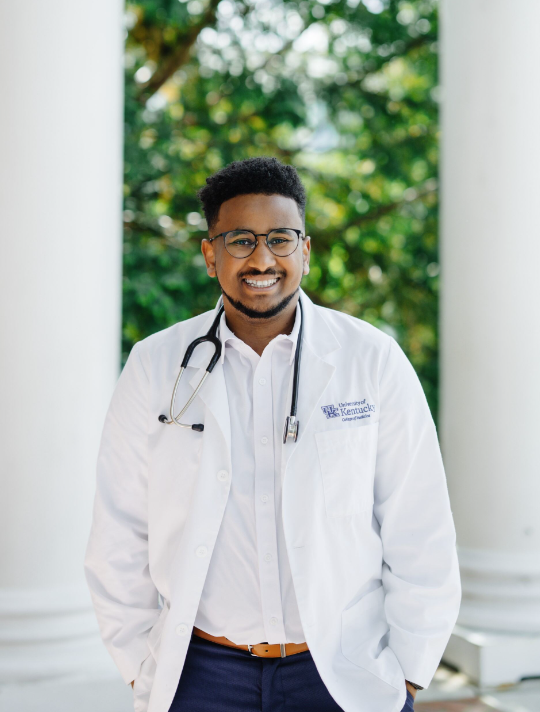
Kidus Shiferawe’s path to medicine has been shaped by two places that might seem worlds apart — Addis Ababa, Ethiopia, and eastern Kentucky. His experiences living in both, however, revealed the same urgent reality: for many rural communities, getting timely, specialized care can be difficult.
Now graduating from the University of Kentucky College of Medicine and preparing to begin an internal medicine residency at Mayo Clinic, Shiferawe reflects on the experiences, mentors, and patient moments that have guided him, and the kind of physician he hopes to become.
Q. What first drew you to medicine/health care?
A. Originally from Addis Ababa, Ethiopia, my journey toward medicine has been shaped by my experiences growing up in both East Africa and eastern Kentucky. In Ethiopia, I often served as a translator for my family in health care settings.
But it was in my late teens that I truly began to understand medicine as my calling. In many rural communities in Ethiopia, preventable illnesses such as acute respiratory infections and diarrheal diseases can become life-threatening because of limited access to care. From that point forward, my path became clear: I wanted to become a physician.
Q. What drew you to the UK College of Medicine, specifically?
A. The story that began in Ethiopia continued in Kentucky. While attending boarding school in Clay County, I had to travel nearly two hours to see the nearest endocrinologist. That experience opened my eyes to the health care challenges facing rural America.
Aside from chicken being a favorite meal — “doro wat” in Ethiopia and fried chicken in Kentucky — eastern Africa and Kentucky may not seem to have much in common. Yet I found a striking similarity: rural communities in both places face significant barriers to health care access.
That realization strengthened my commitment to improving health care access in both Ethiopia and Kentucky. It also motivated me to pursue a Master of Public Health before medical school so I could better understand health equity and the social determinants of health. UK College of Medicine’s mission to improve the health of Kentuckians and beyond, especially those without easy access to care, strongly aligned with my own values and drew me here.
Q. Were there specific experiences, mentors, or moments that helped you grow into the kind of physician you’re becoming?
A. At UK, I learned that a physician’s impact extends far beyond the clinic. Through mentorship experiences, I came to understand that the kind of physician I want to become is someone who invests in people at every level.
During the summer after my M1 year, I served as a resident assistant for the UK Medical Education Development Program, an initiative designed to recruit and support underrepresented and rural students interested in medicine. I had the privilege of continuing to mentor students from that program, and seeing some of them later gain acceptance to medical school was incredibly rewarding.
I also had the opportunity to speak with high school students at Carter G. Woodson Academy about medicine and the path to becoming a physician. During medical school, I served as a med mentor and as a member of the admissions committee, which gave me additional opportunities to support and help shape the next generation of physicians. I hope to carry that spirit of mentorship throughout my career.
Q. Can you share a patient experience, project, or moment in training that has stayed with you? What made it meaningful?
A. During my acting internship as a fourth-year medical student, I cared for a patient from eastern Kentucky with diabetes who was admitted for a nasal abscess. After ENT drained the abscess, she was admitted to medicine for IV antibiotics. During her hospitalization, we discovered that her A1C was very high.
As I got to know her, I learned that no one had ever fully explained the long-term consequences of uncontrolled blood sugar, including its connection to infections. She also did not have a nearby primary care physician or endocrinologist for close follow-up. Understanding her lived experience helped me advocate for keeping her in the hospital long enough to develop a safe and realistic diabetes plan.
That experience stayed with me because I was once a patient with diabetes in eastern Kentucky myself. I understood some of the unique challenges she faced, and that connection helped me provide more compassionate and effective care.
Q. Were there opportunities — research, clinical rotations, or otherwise — that pushed you to think differently or expand your perspective?
A. Through the Clinical and Translational Research Concentration, I became involved in a project with Dr. Kato [Hirotaka Kato, MD, associate professor of internal medicine], examining marginalized groups in the context of lung cancer screening. Using innovative methods, we studied how socioeconomic, geographic, and clinical factors intersect to contribute to health disparities.
This work expanded my perspective because it showed me that marginalized communities rarely experience disparities because of one single factor. More often, disparities arise from the intersection of multiple barriers. Addressing them requires an equally thoughtful and multifaceted approach. This research reflects my broader goal of using evidence to inform policy and improve care for marginalized populations.
Q. As you prepare to leave Kentucky for residency, how do you feel your training at UK has prepared you to take the next step?
A. I truly believe that the UK College of Medicine has some of the best educators and physicians. As a referral center for much of eastern Kentucky and Appalachia, UK exposed me to a wide range of pathology and patient experiences. That clinical exposure, combined with outstanding teaching and mentorship, has prepared me to enter residency with confidence.
Q. What is something about your journey to this point that people might not see — but has been important in shaping who you are today?
A. At age 15, I immigrated to the United States alone from Ethiopia to attend a boarding school, leaving behind my family, language, and culture. Navigating life independently at such a young age taught me resilience, adaptability, and self-reliance; qualities that have carried me through medical school and will carry me through residency in a new state.
As someone living with type 1 diabetes, I have also learned to balance the demands of clinical training with the realities of chronic illness. This perspective has shaped my empathy and deepened my understanding of the patient experience.
Q. What excites you most about this next step in your journey?
A. When my parents sent me to the United States at a young age, it was so I could pursue my dreams. At graduation, that dream becomes real: I get to become a doctor and begin residency in internal medicine at Mayo Clinic.
I have dreamed of this day since I was 15, and now that it is here, it is hard to fully put into words. Although I will be leaving Kentucky for residency, Kentucky will always be home and will remain a major part of who I am.
Q. What kind of impact do you hope to have as a physician, wherever your career takes you?
A. I was initially drawn to internal medicine because of its complexity and the opportunity to care for multiple organ systems at once. But what truly fuels my passion is that internal medicine allows me to care for the whole patient — not only addressing their immediate medical needs, but also considering the social and structural factors that affect their health.
I hope to build a career in academic internal medicine focused on improving health outcomes, addressing health care disparities, and mentoring the next generation of diverse physician leaders.
Q. If you could go back to your first day of medical school, what would you tell yourself?
A. One of my favorite African proverbs says, “If you want to go fast, go alone. If you want to go far, go together.”
That is what I would tell myself — and anyone starting medical school: lean into your community. Rely on the great teachers and mentors around you. Build strong friendships, learn from one another, and most importantly, have fun along the way.